Tourism Destinatons
About Ngawi Regency
GEOGRAPHICALY
Ngawi Regency located about 182 kilometers in the west of
Surabaya, 80 kilometers in the east of Solo, Central Java,
and 53 kilometers in the north of Madiun. Monument of R.M.
SURYO, the first governor of East Java, is about 2 hoursdrive
from the town, 181 km, from Surabaya. The total of its width
is 129.598 hectares consist of 51.386 hectares of rice field,
44.843 hectares of productive forest and the rest is functioned
as field, dry field (dry field farming), plantation, land
prepared for industrial area etc.
TOPOGRAPHICALLY
- Ngawi Regency is decorated with two big rivers and their stream, a large piece of lime mountain land, and a big piece of fertile mountain land and most of its region constitutes a big piece of fertile plains between the two mountains and rivers mentioned above.
- The Solo river flows from west, confining the land of lime mountain in the region of North Ngawi (Kendeng mountain/Kapur Tengah, Mediterranean and Litosol type of land covers 35 % of Ngawi Region) with fertile plains extends in the central region of Ngawi (Grumoso land type), covers 43 % of Ngawi Region till it touches the foot of mount Lawu in the south west angle.
- Madiun rivers flows from the south in the east side of Ngawi Region peviding the big piece of the fertile plains, then it meets with Solo rivers in the north-edst angle of Ngawi city.
- Along the two rivers, alluvial type of soil spreads as wide as 9 % of Ngawi Region and the rest of 13 % of its regions consists of Andosol, Latosol and Regosol types of land, which most of them are in the plain of Lawu mountain.
- In the dry season the temperature in
Ngawi is between 28 and 31 degrees Celsius, in the rainy
season from 28 up to 30 degrees, except in the top slope
of Lawu mountain, with sufficiently high humidity. Rain
fall is between 1.500 milimeters/year (in Kendeng mountain
) and 2.600 milimeters/year (in the foot of Lawu mountain
).
The potential of cultural attractions in Ngawi, is offering the art products of its people, which can be performed any time such as; reog dance, orek-orek dance, gaplik art, kecetan, the art of puppet playing, wood carting, calligraphy and many others.

Over The Dam
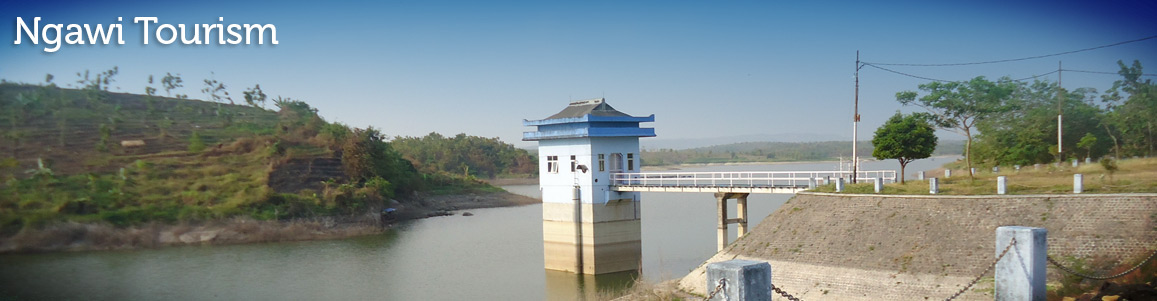
Pondok Dam Pondok Dam is located in Dero village, Bringin district, about 6 km east of Ngawi. It is a popular tourism object among the local tourists. Beside its functions as irrigation purposes, it also offers variety recreational activities such as; fishing, motor boating, camping, playground etc. Pondok Dam is the answer to spend of our day, because it has beautifull and natural scenery. This location has surrounded by Mahoni and teak trees. The total of water area is more than 2,596 hectares. Pondok Dam is offers a lot of…
The Gate To Tawun Park Ngawi
Tawun Park Tawun recreational park and swimming pool is located about 7 kilometers in the east of Ngawi city. Apart from its beauty the park also provides man-made lake equipped with facilities as canoes, mini animal park, fishing arena, tortoise pond, and swimming pool. In this place, the people around always held a traditional sacred ritual ceremony, which called “Keduk beji”. This traditional ceremony always held once a year on Tuesday Kliwon (Javanese calendar) after successful harvest. Visit Tawun recreational park in Ngawi that offers the interesting nature scenery. More…
Tawun Park, The Pool And The Lake
Tawun Recreational Park Tawun recreational park and swimming pool is located about 7 kilometers in the east of Ngawi city. Apart from the beauty, the park is also provides artificial lake equipped with facilities as canoes, mini animal park, fishing arena, tortoise pond, and swimming pool. In this place, the people around ar always held a traditional sacred ritual ceremony, which called “Keduk beji”. This traditional ceremony always held once a year on Tuesday Kliwon (Javanese calendar) after successful harvest. More info visit www.eastjava.com
Pondok Dam Ngawi
Pondok Dam Pondok Dam is located in Dero village, Bringin district, about 6 km east of Ngawi. It is a popular tourism object among the local tourists. Beside its functions as irrigation purposes, it also offers variety recreational activities such as; fishing, motor boating, camping, playground etc. Pondok Dam is the answer to spend of our day, because it has beautifull and natural scenery. This location has surrounded by Mahoni and teak trees. The total of water area is more than 2,596 hectares. Pondok Dam is offers a lot of…